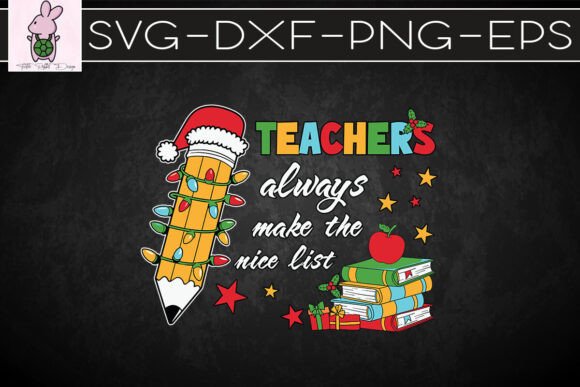
Teachers Always Make Nice List SVG
A Warm, Witty Design That Stitches Well—If You Use It Right
I pulled up Teachers Always Make Nice List SVG last week while prepping for a holiday batch of embroidered tote bags for a local teacher appreciation pop-up. My goal? A cheerful, slightly nostalgic design that feels handmade—not mass-produced—and carries genuine warmth without tipping into cutesy overload. Right away, the layout landed: clean curves, balanced spacing, and that gentle upward tilt in the “Nice List” text—like a knowing smile stitched in thread. It’s not flashy, but it’s confident. And for embroidery designers who know how easily whimsy turns muddy under dense satin stitch or thin lettering, that restraint is a feature—not a flaw.
Where This Design Truly Shines
This isn’t a one-size-fits-all embroidery file—it’s a mood-setter with clear sweet spots. I tested it on midweight cotton twill tote bags first (hoop size: 4” x 4”), and the result was instantly shop-ready: crisp edges, legible lettering at 3.5”, and zero thread nesting in the “Always” curve. It performed just as well on a soft unisex sweatshirt—especially when paired with a subtle tonal thread (navy on heather grey), letting the message stand out without shouting.
It also translated beautifully to baby items: a mini version (scaled to 2.75”) stitched cleanly onto a cotton muslin bib using lightweight tear-away stabilizer. The rounded corners and open letterforms avoided the dreaded “stitched-in-mud” look that plagues tighter scripts on delicate fabric. As an embroidered patch? Yes—especially when fused to denim aprons or canvas backpacks for school staff gifts. And for Etsy sellers building seasonal listings, this design works seamlessly in printable mockups: the high-res PNG with transparent background dropped cleanly into lifestyle scenes, and the SVG held sharpness across sizes in design software.
Real-World Limits—And Why They Matter
That said, Teachers Always Make Nice List SVG isn’t magic. On stretchy fabrics like cotton-spandex t-shirts, I saw minor distortion in the lower curve of “List” unless I used cutaway + topping combo—so if you’re planning custom apparel for teachers’ lounge wear, test that pairing first. On dark fabric, the lighter-weight fill areas (especially the inner curve of the “A” in “Always”) softened visually unless I boosted contrast with a slightly heavier fill stitch or added a subtle outline. And cap fronts? Tricky. The design’s width stretches comfortably across flat panels—but on curved, low-profile caps, I recommend trimming the outermost 1/8” of the “Teachers” baseline or opting for a simplified version. No point forcing elegance where hoop clearance won’t allow it.
Also worth noting: while the lettering reads clearly at 3”+, the “Nice List” subline loses definition below 2.25”. So for tiny embroidered patches (think 1.75” keychains or baby onesie accents), lean into the main phrase only—or treat it as a standalone applique design with clean satin-stitched edges instead of dense fill.
What It Adds to Your Finished Product—Beyond the Stitch
Here’s what surprised me most: how much Teachers Always Make Nice List SVG elevates perceived value—not because it’s complex, but because it *feels intentional*. Customers don’t buy fonts; they buy tone, recognition, and emotional resonance. This design lands as warm, respectful, and quietly proud—perfect for handmade products that honor educators without leaning on clichés (no apples, no chalkboards, no forced puns). That builds trust, especially for small shop owners and craft fair vendors whose buyers scan quickly for authenticity.
For Etsy sellers, it supports strong brand consistency: pair it with neutral thread palettes (cream, charcoal, forest green) and it fits naturally into cohesive collections—teacher gift bundles, back-to-school nursery decor, or boutique-branded staff appreciation kits. And because it avoids over-detail, it photographs well on product listings: no fuzzy edges, no shadowed corners, no pixelation in thumbnails. That directly impacts buyer engagement—especially for digital embroidery file buyers who preview before purchasing.
Practical Designer Notes Before You Stitch
- Always test on scrap fabric first—especially if stitching on textured weaves (like linen tea towels) or layered garments (reversible aprons).
- Check thread color contrast early: light thread on light fabric can fade the shape; dark-on-dark needs careful stitch density control.
- Review stitch density in your embroidery software—if it’s over 12,000 stitches, consider simplifying curves for baby items or frequent-wash products like kitchen towels.
- Confirm hoop size compatibility: the full design fits comfortably in a 4” x 4” hoop, but verify exact dimensions in your software before scaling for smaller projects.
- Inspect small details at 200% zoom: check for stray nodes or overlapping paths that could cause jump stitches or thread breaks.
- Test black-and-white mockups to assess visual weight—this design relies on shape and rhythm more than fine detail, so clarity should hold even without color.
- Use proper stabilizer: lightweight cutaway for knits, tear-away for stable wovens, and fusible + topping for nap-heavy fabrics like fleece.
- Verify licensing terms before selling finished embroidered items or bundling the file commercially—this is essential for craft business owners and digital product sellers.
Final Thought: A Quietly Effective Tool for Meaningful Makes
Teachers Always Make Nice List SVG won’t wow with technical fireworks—but it delivers something rarer in the Crafts and Graphics space: reliability with personality. It’s the kind of embroidery file that disappears into your project just enough to let the sentiment shine, yet holds up under real-world stitching conditions. Whether you’re embroidering a holiday gift for your child’s favorite educator, building a small shop collection around appreciation themes, or sourcing clean design assets for client work, this one earns its place in your library—not because it’s loud, but because it’s thoughtful, adaptable, and genuinely nice.